

8 000 In Scientific Notation
Scientific annotation is a form of presenting very big numbers or very small numbers in a simpler form. As we know, the whole numbers can be extended till infinity, but we cannot write such huge numbers on a piece of paper. Also, the numbers which are nowadays at the millions place after the decimal needed to exist represented in a simpler form. Thus, it is difficult to represent a few numbers in their expanded class. Hence, we use scientific notations. Besides learn, Numbers In General Course.
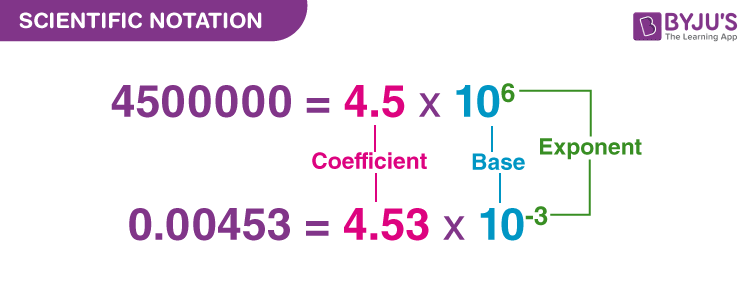
For example, 100000000 tin can be written equally xviii, which is the scientific notation. Here the exponent is positive. Similarly, 0.0000001 is a very modest number which tin be represented as ten-8, where the exponent is negative.
Scientific Notation Definition
As discussed in the introduction, the scientific notation helps us to stand for the numbers which are very huge or very tiny in a form of multiplication of single-digit numbers and x raised to the power of the respective exponent. The exponent is positive if the number is very large and it is negative if the number is very small. Learn ability and exponents for better understanding.
The general representation of scientific annotation is:
Also, read:
- Scientific notation formula calculator
- Scientific Note Calculator
Scientific Notation Rules
To decide the ability or exponent of ten,we must follow the rule listed beneath:
- The base of operations should be always ten
- The exponent must exist a non-zilch integer, that ways information technology can be either positive or negative
- The absolute value of the coefficient is greater than or equal to i simply it should be less than 10
- Coefficients tin can be positive or negative numbers including whole and decimal numbers
- The mantissa carries the balance of the meaning digits of the number
Let the states empathize how many places we need to move the decimal point later the single-digit number with the assistance of the below representation.
- If the given number is multiples of x then the decimal point has to movement to the left, and the ability of ten will be positive.
Instance: 6000 = 6 × 10three is in scientific notation. - If the given number is smaller than ane, then the decimal point has to move to the right, so the power of 10 will be negative.
Example: 0.006 = 6 × 0.001 = 6 × 10⁻³ is in scientific note.
Scientific Notation Examples
The examples of scientific notation are:
490000000 = 4.9×ten8
1230000000 = ane.23×x9
50500000 = 5.05 x x7
0.000000097 = ix.seven 10 x-eight
0.0000212 = ii.12 10 10-5
Positive and Negative Exponent
When the scientific notation of whatever large numbers is expressed, then nosotros use positive exponents for base 10. For example:
20000 = 2 x ten4, where 4 is the positive exponent.
When the scientific notation of whatsoever pocket-sized numbers is expressed, then we employ negative exponents for base 10. For example:
0.0002 = 2 x 10⁻⁴, where -4 is the negative exponent.
From the above, we can say that the number greater than 1 tin be written as the expression with positive exponent, whereas the numbers less than i with negative exponent.
Bug and Solutions
Question i: Convert 0.00000046 into scientific notation.
Solution: Move the decimal indicate to the right of 0.00000046 up to 7 places.
The decimal betoken was moved seven places to the right to class the number 4.6
Since the numbers are less than 10 and the decimal is moved to the right. Hence, nosotros apply a negative exponent here.
⇒ 0.00000046 = four.6 × 10-7
This is the scientific notation.
Question two: Catechumen 301000000 in scientific notation.
Solution: Move the decimal to the left 8 places and so it is positioned to the correct of the leftmost not zero digits 3.01000000. Remove all the zeroes and multiply the number by ten.
At present the number has become = iii.01.
Since the number is greater than x and the decimal is moved to left, therefore, we use here a positive exponent.
Hence, 3.01 × ten8 is the scientific notation of the number.
Question iii:Catechumen 1.36 × ten7 from scientific note to standard notation.
Solution: Given, 1.36 × x7 in scientific annotation.
Exponent = seven
Since the exponent is positive we need to move the decimal identify 7 places to the right.
Therefore,
ane.36 × x7 = i.36 × 10000000 = i,36,00,000.
Practice Questions
Trouble 1: Convert the following numbers into scientific notation.
- 28100000
- 7890000000
- 0.00000542
Problem 2: Convert the post-obit into standard form.
- 3.5 × 10⁵
- 2.89 × ten-6
- 9.8 × x-ii
Oftentimes Asked Questions on Scientific Notation – FAQs
How do y'all write 0.00001 in scientific notation?
The scientific note for 0.0001 is i × 10^{-4}.
Here,
Coefficient = ane
Base = 10
Exponent = -4
What are the 5 rules of scientific annotation?
The 5 rules of scientific notation are given below:
1. The base should be always 10
two. The exponent must exist a not-null integer, that means it can exist either positive or negative
3. The absolute value of the coefficient is greater than or equal to i but information technology should exist less than ten
4. Coefficients can be positive or negative numbers including whole and decimal numbers
5. The mantissa carries the balance of the meaning digits of the number
What are the 3 parts of a scientific notation?
The three principal parts of a scientific notation are coefficient, base and exponent.
How do you lot write 75 in scientific notation?
The scientific notation of 75 is:
7.5 × 10^1 = 7.5 × x
Here,
Coefficient = seven.5
Base = ten
Exponent = one
How exercise yous put scientific notation into standard form?
To catechumen a number from scientific notation to standard form, nosotros should motion the decimal indicate (if any) to the left if the exponent of 10 is negative; otherwise, proceed to the correct. We must shift the decimal bespeak as many times as the exponent indicates in power and so that there volition be no powers of 10 in the final representation.

8 000 In Scientific Notation,
Source: https://byjus.com/maths/scientific-notation/
Posted by: osorioappithe.blogspot.com
0 Response to "8 000 In Scientific Notation"
Post a Comment