

Is Soap Soluble In Water
3.6: Application of Solubility- Soap
- Page ID
- 30326
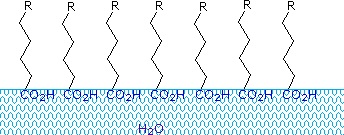
Carboxylic acids and salts having alkyl bondage longer than viii carbons exhibit unusual behavior in water due to the presence of both hydrophilic (CO2) and hydrophobic (alkyl) regions in the same molecule. Such molecules are termed amphiphilic (Gk. amphi = both) or amphipathic. Fatty acids made upward of 10 or more carbon atoms are almost insoluble in water, and because of their lower density, float on the surface when mixed with water. Unlike alkane series or other alkanes, which tend to puddle on the waters surface, these fatty acids spread evenly over an extended water surface, eventually forming a monomolecular layer in which the polar carboxyl groups are hydrogen bonded at the water interface, and the hydrocarbon bondage are aligned together away from the water. This behavior is illustrated in the diagram on the right. Substances that accumulate at water surfaces and change the surface properties are chosen surfactants.
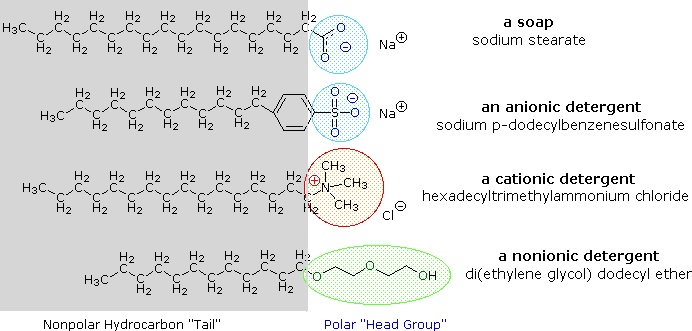
Alkali metal salts of fatty acids are more than soluble in h2o than the acids themselves, and the amphiphilic character of these substances likewise make them potent surfactants. The most mutual examples of such compounds are soaps and detergents, four of which are shown below. Notation that each of these molecules has a nonpolar hydrocarbon chain, the "tail", and a polar (oftentimes ionic) "head grouping". The use of such compounds equally cleaning agents is facilitated past their surfactant grapheme, which lowers the surface tension of water, allowing it to penetrate and wet a variety of materials.
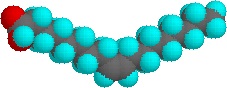
The oldest amphiphilic cleaning agent known to humans is lather. Soap is manufactured by the base-catalyzed hydrolysis (saponification) of animate being fat (see below). Earlier sodium hydroxide was commercially available, a boiling solution of potassium carbonate leached from wood ashes was used. Soft potassium soaps were then converted to the harder sodium soaps by washing with common salt solution. The importance of soap to human civilization is documented past history, but some problems associated with its utilise have been recognized. One of these is caused by the weak acerbity (pKa ca. 4.ix) of the fatty acids. Solutions of brine metallic soaps are slightly alkaline (pH 8 to nine) due to hydrolysis. If the pH of a soap solution is lowered by acidic contaminants, insoluble fatty acids precipitate and form a scum. A second problem is caused by the presence of calcium and magnesium salts in the water supply (hard h2o). These divalent cations crusade aggregation of the micelles, which then deposit as a dirty scum.
These issues have been alleviated by the development of synthetic amphiphiles called detergents (or syndets). By using a much stronger acid for the polar caput group, water solutions of the amphiphile are less sensitive to pH changes. Also the sulfonate functions used for virtually all anionic detergents confer greater solubility on micelles incorporating the alkali metal earth cations found in hard water. Variations on the amphiphile theme have led to the development of other classes, such equally the cationic and nonionic detergents shown higher up. Cationic detergents often exhibit germicidal properties, and their power to change surface pH has fabricated them useful as textile softeners and hair conditioners. These versatile chemical "tools" take dramatically transformed the household and personal care cleaning product markets over the past fifty years.

Is Soap Soluble In Water,
Source: https://chem.libretexts.org/Bookshelves/Organic_Chemistry/Map:_Organic_Chemistry_%28Smith%29/03:_Introduction_to_Organic_Molecules_and_Functional_Groups/3.06:_Application_of_Solubility-_Soap?readerView
Posted by: osorioappithe.blogspot.com
0 Response to "Is Soap Soluble In Water"
Post a Comment